

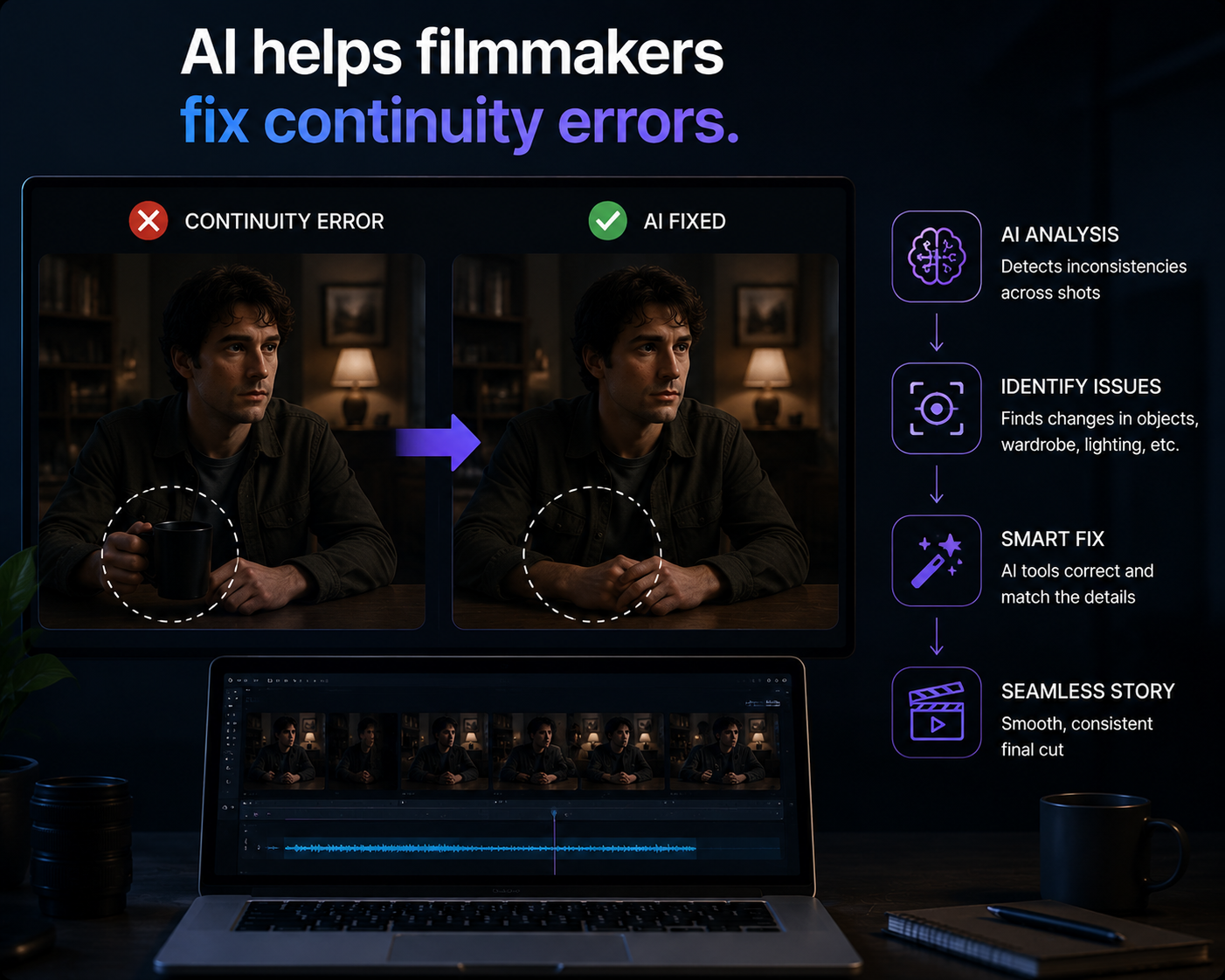
Continuity is one of the most important elements of filmmaking. A scene can have excellent performances, strong visuals, and impressive cinematography, but even small continuity mistakes can pull viewers out of the story.
A character’s clothing changing between shots, an object moving unexpectedly, inconsistent lighting, or a location appearing different from one scene to another can affect the overall viewing experience. In traditional filmmaking, continuity teams, script supervisors, editors, and production crews carefully track these details to maintain consistency throughout a project.
However, managing continuity becomes increasingly difficult as productions become larger and more complex. Multiple shooting days, changing locations, visual effects, and extensive editing can create more opportunities for mistakes.
AI tools are now helping filmmakers identify, manage, and correct continuity issues more efficiently. By analyzing visual details, maintaining creative references, and supporting post-production workflows, AI is becoming a valuable tool for creating smoother and more consistent videos.
Why Continuity Errors Are Challenging in Filmmaking
Continuity errors happen when elements within a scene do not match between different shots. While some mistakes may be obvious, many are subtle and difficult to catch during production.
A filmmaker may need to maintain consistency across:
- Character appearance
- Wardrobe and accessories
- Props and objects
- Lighting conditions
- Camera angles
- Locations and backgrounds
- Character positions
- Visual style
For example, a character may be holding a coffee cup in one shot and suddenly not have it in the next. A scene filmed in the morning may accidentally appear to have evening lighting after editing. A product shown in a commercial may have slightly different details across multiple shots.
These issues become even harder to manage in large productions where hundreds of shots need to work together as one continuous story.
How AI Helps Detect Continuity Problems Earlier
One of the biggest advantages of AI in filmmaking is its ability to analyze large amounts of visual information quickly.
AI-powered tools can compare different shots and identify potential inconsistencies that may be difficult for humans to notice during a busy production schedule.
For example, AI can help analyze whether:
- A character’s appearance remains consistent
- A prop changes position unexpectedly
- The lighting matches between connected shots
- Background details remain stable
- Visual styles stay aligned
By identifying these issues earlier, filmmakers can address problems before they become expensive fixes during post-production.
AI Helps Maintain Character Consistency Across Scenes
Characters are one of the most important areas where continuity matters.
A small change in appearance can affect how audiences perceive a character. This is especially important for AI-generated characters, digital actors, and visual effects-heavy productions.
AI workflows can help filmmakers maintain consistency in areas such as:
- Facial features
- Hairstyles
- Clothing
- Body proportions
- Expressions
- Character styling
Instead of recreating characters from scratch for every scene, AI-assisted workflows can use references and creative context to maintain a more consistent identity.
This is valuable for filmmakers creating longer stories where the same characters appear across many different environments and situations.
Fixing Visual Continuity Through AI Editing
Post-production is often where continuity issues become most noticeable.
Editors may discover that two shots do not match because of changes in lighting, backgrounds, objects, or character details. Traditionally, fixing these problems could require reshoots, manual editing, or complex visual effects work.
AI editing tools are helping simplify some of these corrections by supporting tasks such as:
- Removing unwanted objects
- Replacing backgrounds
- Adjusting visual elements
- Enhancing image consistency
- Matching different shots
These capabilities allow editors to make corrections without rebuilding entire scenes.
AI Helps Preserve Visual Style Across a Film
Continuity is not only about objects and characters. It also involves the overall visual language of a project.
A film’s identity comes from elements such as:
- Color grading
- Lighting style
- Camera approach
- Mood
- Composition
If one scene feels completely different from the rest of the film, the audience may notice the inconsistency.
AI tools can help filmmakers maintain a more unified visual style by analyzing references and supporting consistent creative decisions throughout production.
This is especially useful for projects created over long periods where different scenes may be filmed under different conditions.
AI-Assisted Editing Makes Continuity Corrections Faster
Editors often spend significant time searching through footage to identify and fix continuity problems.
AI can help reduce this workload by assisting with:
- Finding similar shots
- Organizing footage
- Identifying visual differences
- Suggesting editing improvements
- Automating repetitive corrections
Instead of manually reviewing every frame, editors can use AI to highlight areas that may require attention.
This allows creative teams to spend more time focusing on storytelling decisions.
AI Agents Are Helping Maintain Context Throughout Production
One of the biggest challenges in filmmaking is keeping creative decisions connected across different stages of production.
A filmmaker may establish a character design, lighting approach, or visual style early in the process, but maintaining those choices throughout editing and additional scenes can become difficult.
AI-assisted filmmaking workflows are helping solve this by keeping important project details connected.
Invideo Agent supports a more connected video creation workflow by helping creators move from concepts and scripts to scene development, generation, editing, and refinement. For filmmakers working on projects with multiple scenes, this approach helps maintain creative context instead of treating every shot as an isolated piece.
This can be useful when correcting continuity issues because the overall direction of the project remains connected throughout production.
How Invideo Agent Two Supports Complex Projects
As productions become more complex, continuity management requires stronger coordination between different creative elements.
Invideo Agent Two builds on this type of workflow by helping teams manage larger projects where multiple creative decisions need to stay aligned. By supporting areas such as cinematography, story planning, casting, and visual effects workflows, it helps filmmakers maintain a shared understanding of the project direction.
For multi-scene productions, this type of connected approach can help reduce inconsistencies between characters, environments, and visual styles.
AI Helps Fix Continuity in Virtual Production
Virtual production has introduced new possibilities for filmmakers, but it also creates new continuity challenges.
Digital environments, virtual characters, and generated elements need to remain consistent throughout a production.
AI can support virtual production by helping manage:
- Digital environments
- Character references
- Lighting conditions
- Camera perspectives
- Visual effects elements
This allows filmmakers to create more believable worlds while maintaining consistency across multiple shots.
Reducing Continuity Errors in AI-Generated Videos
AI-generated videos introduce their own continuity challenges.
A generated character may change appearance between scenes, backgrounds may shift unexpectedly, or objects may not remain identical across different generations.
To address these challenges, filmmakers are increasingly using workflows that focus on:
- Reference-based generation
- Consistent character development
- Connected project context
- Controlled visual direction
The future of AI filmmaking is moving away from creating isolated clips and toward generating complete sequences where every element remains connected.
Human Creativity Still Guides Continuity Decisions
While AI can help identify and fix many continuity problems, human judgment remains essential.
Filmmakers still decide whether a change improves the story or creates a problem. Not every difference between shots is an error. Sometimes changes are intentional creative choices.
Directors and editors determine:
- Which details need to remain consistent
- Which visual changes support the story
- How scenes should flow emotionally
- What the audience should notice
AI works best as a creative assistant that helps filmmakers maintain control over complex projects.
The Future of AI-Assisted Continuity Management
As AI filmmaking tools continue to improve, continuity management will become a more integrated part of the production process.
Future workflows will likely combine visual analysis, editing assistance, project memory, and creative collaboration to help filmmakers maintain consistency from pre-production through final delivery.
Instead of discovering continuity problems after filming, creators will increasingly be able to prevent them during planning and production.
Final Thoughts
Continuity errors have always been one of the hidden challenges of filmmaking. Maintaining consistency across characters, locations, props, lighting, and visual style requires careful planning and attention to detail.
AI tools are helping filmmakers manage this challenge by detecting inconsistencies, supporting corrections, and keeping creative decisions connected throughout production.
The goal is not to remove the human role in filmmaking but to give creators better tools to protect their vision. By combining AI-assisted workflows with human storytelling, filmmakers can create smoother, more immersive, and more consistent video experiences.








Discussion about this post